Table of Contents: [ ]
- How to access the 10.0.0.1 admin page
- What is 10.0.0.1?
- Why can many routers use the same 10.0.0.1 address?
- What can you manage through 10.0.0.1?
- 10.0.0.1 will not open: what to check first
- How to find your router's IP address on Windows
- The login page opens but the password does not work
- Should you reset the router if you forgot the login?
- Is 10.0.0.1 the same as a public IP address?
- Is 10.0.0.1 only for Xfinity or Piso WiFi?
- Changing the router's local IP address
- Before changing network settings
If 10.0.0.1 is your router or gateway address, connect to that network first, then open the address directly in your browser's address bar.
How to access the 10.0.0.1 admin page
Before opening 10.0.0.1, make sure your phone, computer or tablet is connected to the router or gateway you want to manage. You can connect over Wi-Fi or Ethernet.
- Open Chrome, Edge, Safari, Firefox or another web browser.
- Click the browser's address bar and enter 10.0.0.1.
- If your router uses this address, its sign-in or management page should appear.
- Enter the administrator credentials assigned to that device.
- After signing in, review the available settings before making changes.

Do not assume that every device uses admin/admin. Some older equipment used common default credentials, while many newer routers use a unique password printed on the device or require an administrator password to be created during initial setup.
What is 10.0.0.1?
10.0.0.1 is an IPv4 address inside the private 10.0.0.0/8 network. Private addresses are intended for communication inside local networks and are not routed directly across the public Internet.
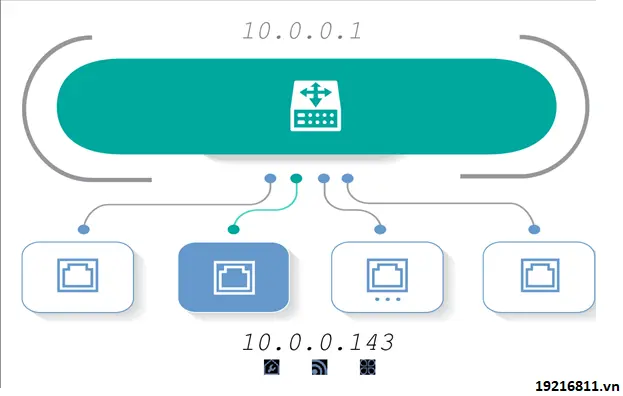
A router or gateway can use 10.0.0.1 as its LAN address and default gateway. Devices connected to that network may then send traffic destined for other networks through 10.0.0.1.
The address itself does not identify a particular router manufacturer or internet provider. Different devices can use 10.0.0.1, and the same device may also be configured to use another private address.
Why can many routers use the same 10.0.0.1 address?
Private IP addresses only need to be unique within the local network where they are being used. Two unrelated homes, offices or other private networks can therefore both use 10.0.0.1 without conflicting with each other.
The IPv4 address blocks reserved for private networks are:
- 10.0.0.0 to 10.255.255.255 — 10.0.0.0/8
- 172.16.0.0 to 172.31.255.255 — 172.16.0.0/12
- 192.168.0.0 to 192.168.255.255 — 192.168.0.0/16
10.0.0.1 belongs to the first and largest of these private IPv4 ranges.
What can you manage through 10.0.0.1?
If 10.0.0.1 is the management address of your router or gateway, the admin interface may provide access to settings such as:
- Wi-Fi network name (SSID)
- Wi-Fi password and wireless security
- Connected devices
- LAN and DHCP settings
- DNS settings
- Guest Wi-Fi
- Parental controls or access restrictions
- Port forwarding
- Firewall options
- Firmware updates
- Network diagnostics
The exact menu names differ between manufacturers, models and firmware versions. Avoid changing WAN, DHCP, DNS, VLAN or routing settings unless you know what the existing values are and what the change will do.
10.0.0.1 will not open: what to check first
If the browser cannot reach 10.0.0.1, the most common explanation is that the current router uses a different gateway address. Check the network connection before resetting anything.
- Confirm that the device is connected to the correct Wi-Fi or Ethernet network.
- Enter 10.0.0.1 in the browser address bar rather than a search box.
- Make sure you did not enter 10.0.0.0.1, which is not a valid IPv4 address.
- Temporarily disable mobile data if you are troubleshooting from a phone.
- Try another browser or a private/incognito window.
- Check the device's current default gateway instead of guessing different IP addresses.
If another address appears as your default gateway, use that address instead of 10.0.0.1.
How to find your router's IP address on Windows
Windows can show the gateway currently assigned to your network connection.
- Open the Start menu.
- Search for Command Prompt or CMD.
- Run Command Prompt and enter ipconfig.
- Locate the active Wi-Fi or Ethernet adapter.
- Look for the value next to Default Gateway.
If Default Gateway shows 10.0.0.1, that is strong confirmation that 10.0.0.1 is the local gateway for your current network.
The login page opens but the password does not work
Reaching the login page means your device can communicate with the router or gateway, but it does not confirm which administrator credentials are required.
Check the label on the router, gateway or modem, the original setup documentation, or the instructions supplied by your internet provider. Some devices use a unique administrator password rather than a universal default password.
If the administrator password was changed previously, the original factory password will normally no longer work.
Should you reset the router if you forgot the login?
A factory reset should normally be a last resort. It can erase the current Wi-Fi name and password, internet connection settings, port forwarding rules, parental controls and other customized settings.
If you must reset the device, follow the instructions for the exact router or gateway model. The required button location and hold time are not identical across all hardware, so a universal “hold RESET for 10 seconds” or “30 seconds” instruction is not reliable.
For equipment supplied by an ISP, make sure you know whether any provider-specific configuration will be restored automatically before performing a factory reset.
Is 10.0.0.1 the same as a public IP address?
No. 10.0.0.1 is a private address used inside a local network. A public IP address identifies the Internet-facing side of a connection and can be different from the addresses used by devices inside the network.
Home and office routers commonly use NAT so multiple devices with private addresses can share an Internet connection. In that setup, a computer might have an address such as 10.0.0.25 while the router itself uses 10.0.0.1 as the local gateway.
Is 10.0.0.1 only for Xfinity or Piso WiFi?
No. 10.0.0.1 is a general-purpose private IPv4 address, not an address reserved for one company, product or hotspot system.
Some gateways and captive-portal systems may use 10.0.0.1, but the address alone does not prove that a network is Xfinity, Piso WiFi or any other particular service. Always identify the device from its model, label or network configuration before following vendor-specific instructions.
Changing the router's local IP address
Some routers allow their LAN address to be changed from 10.0.0.1 to another private IP. This can be useful when combining networks, avoiding address conflicts or following a specific LAN addressing plan.
After changing the LAN IP, the old address may stop opening the admin page. You will need to reconnect if necessary and use the new router address.
Changing the local management IP does not by itself provide meaningful protection against Internet-based attacks. Router security depends more on strong administrator credentials, current firmware, appropriate firewall settings and disabling unnecessary remote-management features.
Before changing network settings
Record the existing values before editing important settings. A wrong DHCP, WAN, VLAN, DNS or LAN configuration can disconnect devices or prevent Internet access.
If the router is supplied and managed by your internet provider, some settings may be automatically provisioned or restricted. In that situation, consult the provider's documentation before changing advanced network settings.
FAQ
Do I need to type http:// before 10.0.0.1?
Usually not. Entering 10.0.0.1 directly in the browser address bar is normally enough for the browser to attempt a local connection.
Can I open 10.0.0.1 without an Internet connection?
Yes, in many cases. The admin page is hosted on the local router or gateway, so Internet access is not required as long as your device remains connected to the correct local network.
Why does Google search for 10.0.0.1 instead of opening it?
The address may have been entered into a search field rather than treated as a network address. Select the browser's address bar and enter 10.0.0.1 directly.
Is 10.0.0.0.1 the same as 10.0.0.1?
No. 10.0.0.0.1 contains five numeric sections and is not a valid IPv4 address. The valid address discussed here is 10.0.0.1.
Why does 10.0.0.1 work on one Wi-Fi network but not another?
Different networks can use different gateway addresses. A router on one network may use 10.0.0.1 while another uses 192.168.0.1, 192.168.1.1 or another private IP.
Can two routers both use 10.0.0.1?
Yes if they are on separate networks. If two routers using 10.0.0.1 are placed on the same connected LAN without proper configuration, however, an IP conflict can occur.
Does changing 10.0.0.1 improve router security?
Changing the local router address may help with network organization or address conflicts, but it should not be treated as a primary security measure. Strong administrator credentials, updated firmware and secure management settings are more important.
Why does the browser warn that the 10.0.0.1 connection is not private?
Some router admin interfaces use a local HTTPS certificate that the browser cannot independently verify. Confirm that 10.0.0.1 is actually your router's gateway before proceeding, and do not ignore certificate warnings on unfamiliar networks.
 English
  French
  German
  Indonesian
  Italian
  Japanese
  Polish
  Portuguese
  Russian
  Spanish
  Turkish
  Ukrainian
  Vietnamese
  Arabic
  Netherlands
  Thai
Thai  Chinese
  Taiwan
  Korean
  Swedish